

How much should you talk to your toddler?
Whether the “word gap” between upper class and lower class families really matters (or even exists)

The process of acquiring a language involves way more than simply mastering heaps of vocabulary and a slew of grammatical rules. Speakers also have to learn socially appropriate ways of using the language, including when, with whom, in what registers/styles, and in what contexts.
In 1995, a now-infamous study claimed that young children in higher socioeconomic status (SES) homes hear up to 30 million more words over the course of 4 years than those in lower SES households (Hart & Risley 1995).
Does this mean that the more you speak to your child, the better they eventually become at language? Should you be speaking to your child as much as humanly possible? Are children who receive less language input linguistically disadvantaged compared to children of more loquacious parents? In this issue of the newsletter, we’ll look at what the research says about how much you should be talking to your child, and discuss the infamous 30-million-word gap and whether it’s something you need to worry about.
This is Part 6 of a series on the science of baby talk. Check out previous issues at the links below!
🔢 Articles in This Series
Part 2: What’s the point of baby talk?
Part 4: Do all cultures use baby talk?
Part 6: How much should you talk to your toddler? [this issue]
Part 7: What really matters when talking to your child [forthcoming]
👋🏼 You’re reading Linguistic Discovery, a newsletter about the science and diversity of language—a field known as linguistics. I’m Danny Hieber, a PhD in linguistics who works with indigenous communities to help them document and revitalize their languages. Topics covered in this newsletter include:
⚙️ how language works (cognitive linguistics, language change)
🌍 grammatical diversity in the world’s languages (typology)
ℹ️ explainers of terms and concepts in linguistics
🗣️ language profiles
🗞️ the latest news and research in language and linguistics
⭐ linguistic reviews of books and other media
Paid subscribers also get bonus articles and early access to my in-progress book projects!
What is the “word gap”?
In the early 1990s, researchers Betty Hart and Todd Risley conducted a longitudinal study in which they spent time in the homes of 42 families over the span of 2½ years to document language use between parents and their young children (Hart & Risley 1995; Hart & Risley 2003). They found that the amount that parents talked to their children, measured in number of words per hour, varied tremendously by social class. Over four years, they calculated, those hourly differences accrete to create the purported 30-million-word gap. The table below shows the number of words per hour that children of different social classes experienced in their study, and how those numbers add up over a week, a year, and four years. These calculations are based on the assumption of a 100-hour week (14 waking hours per day).
Parents also differed widely in the average number of utterances they made to the child per hour, as the last column in the table shows. High-SES parents weren’t just using more words, but they were speaking to their children more frequently overall. Higher SES mothers also used more of the features of child-directed speech that are known to correlate with improved language development (Hoff 2003: 1369).
Numerous other studies have produced similar results, showing that children from lower SES families expand their vocabularies at a slower rater than children from higher SES families (see Hoff 2003: 1368 for a summary, as well as Fernald, Marchman & Weisleder 2013). The beginnings of this word gap are evident even as early as 18 months. One study found that by 24 months, children from lower SES households performed at the same level as 18-month-olds from higher SES households on a language processing task (Fernald, Marchman & Weisleder 2013).
However, these patterns aren’t strictly about the numbers per se. Instead, it’s more that children are simply mimicking the speech styles of their parents. Overall, children’s language use mirrors that of their parents: children of parents with larger vocabularies have larger vocabularies themselves; children of parents who spoke more utterances per hour also produced more utterances per hour; children of parents who used a greater variety of words per hour likewise used a wider array of words per hour (Hart & Risley 2003). Each of these tendencies correlates with social class, as the following table shows (from Hart & Risley 2003).
Similar word gaps have been documented for reading as well, with a 1.4-million-word gap by kindergarten (Logan et al. 2019). Middle- and upper-class families are more likely to both have books in the house and engage in reading as an activity with their children (Clark 2024: 59).
High-SES children have also been found to produce more complex grammatical structures at 22 months than low-SES children, and this discrepancy persists for at least the next 18 months (Vasilyeva, Waterfall & Huttenlocher 2008). High-SES parents also use more gestures, which has been found to improve vocabulary learning (Saxton 2017: 93).
ℹ️ Want to learn more about children’s linguistic capabilities develop over time? Check out this issue of the newsletter about how children learn grammatical rules (and how we know):
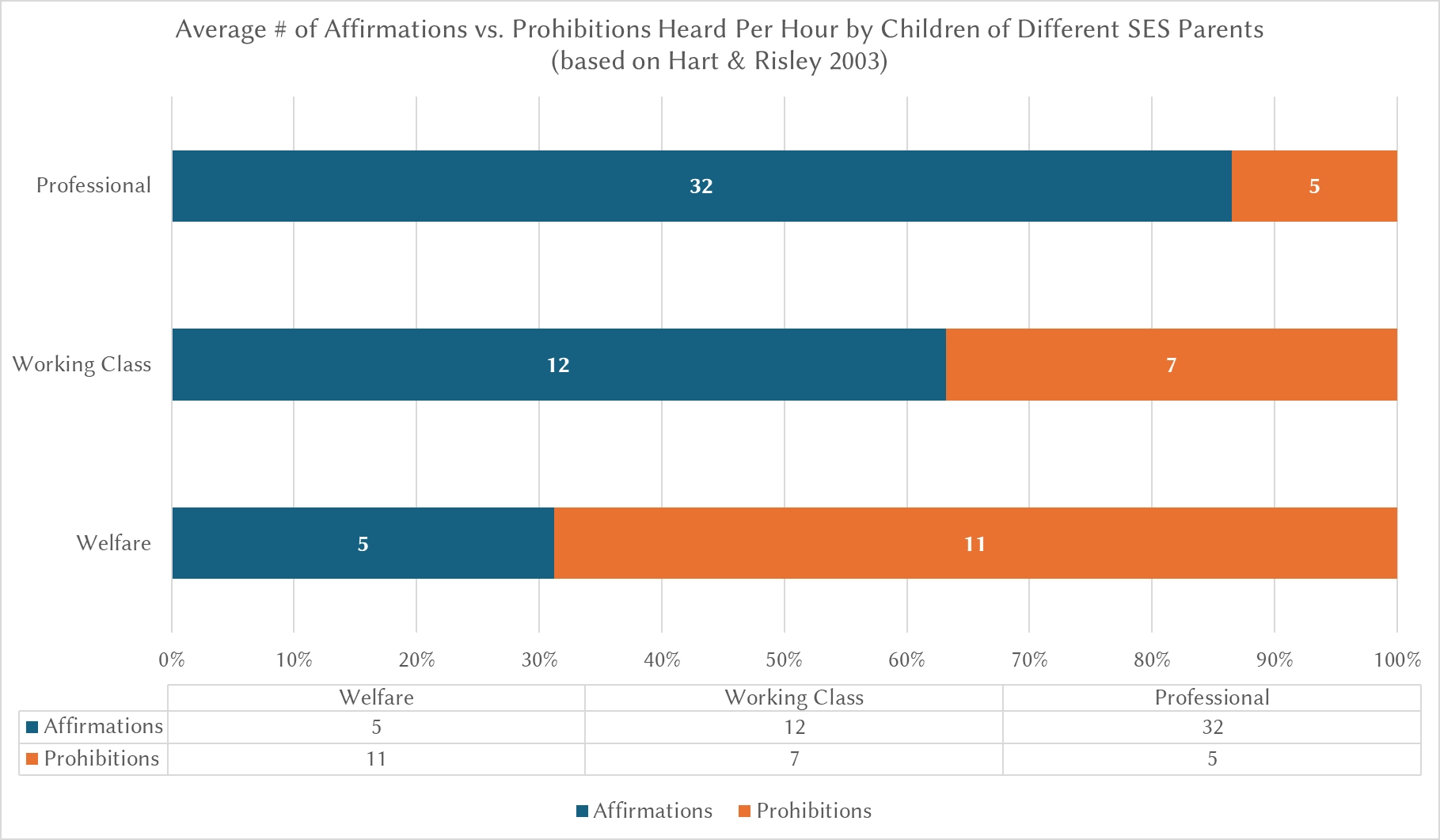
Finally, there are notable differences across social classes in the content of what parents say to their children. Hart & Risley (2003) also examined the number of affirmatives (encouraging words) and prohibitions that parents used with their children. As the following chart shows, parents on welfare used relatively more prohibitions than affirmations with their children, whereas professional-class parents used predominantly more affirmations. Hart & Risley 2003 summarize this by stating, “By the age of 4, the average child in a welfare family might have had 144,000 fewer encouragements and 84,000 more discouragements of his or her behavior than the average child in a working-class family.”
Are these early differences offset or smoothed out later? Is vocabulary acquisition in lower SES families simply somewhat delayed compared to higher SES families, similar to the way that Tsimane (isolate) and Yucatec Maya (Mayan) children don’t hear much child-directed speech in their earliest years but catch up to American children later on (as we saw in Part 4 of this series)? It seems not. These early vocabulary differences persist throughout childhood, correlating to the child’s performance during their school years. Hart & Risley followed up with many of the same children from their original study once they reached third grade (age 9–10), and found that the differences they had documented at age 3 predicted the children’s performance in measures of language skill six years later. And children whose parents engaged in more episodes of joint attention and shared book reading developed larger vocabularies by age 6 (Farrant & Zubrick 2013).
Problems with the word gap theory
The word gap—to the extent it even exists—is a symptom, not a cause, of educational disparities.
Scholars have directed copious criticism at Hart & Risley’s study since its publication, not just at its methods and assumptions, but perhaps more so at its implications (see especially Johnson 2015). One can acknowledge the existence of a word gap between different families of different socioeconomic statuses while also rejecting the catastrophizing claims of Hart & Risley. (Their 2003 paper is even titled, “The early catastrophe: The 30 million word gap by age 3”.) For starters, the number of words parents use with their children is probably not a sufficiently robust measure of what we’d consider a “linguistically stimulating environment”. How parents use language with their children matters much more than how much they use it, as we’ll see in the next and last issue in this series.
The paper’s title also sneakily implies that the 30-million-word gap is already fully present at age 3, but this isn’t what they actually claim in the paper. The initial disparities are present at age 3, but the 30-million-word figure is extrapolated based on what would happen if those disparities continued over four years. We have no idea whether those projections actually hold true. In fact, a more recent replication of Hart & Risley’s study with more participants estimates a word gap closer to 4 million words (Gilkerson et al. 2017). Another study found that when the number of words children overhear (not just words directed specifically at them) is taken into account, the word count increases by 54% for welfare families and 210% for working-class families, with the result that children in poor black families in the study heard fully 21% more words than the professional-class families (Sperry, Sperry & Miller 2019).
Equally damaging to Hart & Risley’s thesis is that the 30-million-word gap turns out to be implausible on its face: it amounts to an additional 24 words per minute, or an additional word every other second for 14 hours/day over 4 years (Purpura 2019: 2). It would be practically impossible to make up for such a colossal gap. So while the many studies I cited in the first section of this article do point to the existence of significant disparities between the language input of children in different SES households, those disparities cannot be nearly as large as they have been claimed to be.
Moreover, the existence of a word gap between different SES households may not even tell us anything useful! Children’s vocabulary size is measured by the number of words they produce, but everybody has a much larger passive vocabulary (words we understand but hardly use) than active vocabulary (words we use regularly). It could be that children in different SES households actually do know the same number of words as each other, but differ in how easily they can recall and use those words, or in the style of speaking they’ve been taught (Hoff 2003: 1375). You might have a lexicon three times the size of an average person, but that difference is unlikely to come across in casual conversation (unless you’re a pedant). Similarly, different families have different speech styles, some more vocabulary-rich than others. (Not every parent is as grandiloquent as Moira Rose, after all.)
It’s also a bit naive to think that the primary reason children from more affluent backgrounds do better on language aptitude tests in school is because of their “supposedly superior linguistic and cognitive capacities that result from early exposure to vocabulary-rich environments” (Johnson 2015: 43). Language aptitude tests by their very nature are forced to utilize objective metrics like understanding word meanings and answering factual questions about a text; but these skills constitute just a small slice of all the things that we use language for. More subjective skills such as making analogies, offering reasons and motivations for a character’s actions, and describing the moral lessons suggested by a text cannot be easily assessed by standardized aptitude tests.
Yet it is precisely these more subjective skills that are often the focus of language use in non-affluent households. One seminal study compared the reading and language socialization habits of parents in white middle-class, white working-class, and black working-class communities, and found that parents differed widely on what language skills they focused on most with their children (Heath 1982). One notable difference is that the white middle-class parents in the study had a greater relative focus on what-explanations when reading (“What’s that?”, “Who’s that?”, “What does the doggie say?”), while white working-class parents focused more on moral lessons, and black working-class parents focused more on reason-explanations (“Why’d he do that?”) as well as analogies and metaphors.
All of these are important skills for children to have, but only one of them (what-explanations) can be easily assessed in standardized tests. School curricula generally begin with what-explanations before moving on to reason-explanations or affective commentary, which are considered more advanced. The white working-class children of Heath’s study are well served by this instructional sequence, but the black working-class children quickly fall behind because they are assumed to have already been taught to answer what-questions when in fact they haven’t.
Similarly, while white working-class parents did ask their children plenty of what-questions during reading, they didn’t connect that information to their everyday lives in the same way that the white middle-class families did. So while the working-class children performed well in the early stages of their school career when faced with what-questions, they too fell behind in later stages. When asked things like, “What did you like about the story?” or “What would you have done if you had been [the main character]?”, the working-class children didn’t know how to respond.
A final illustration of the subjectivity of academic performance is the behavior of Native American children in predominantly white classrooms. On the Warm Springs Indian Reservation in central Oregon, it was noticed that Native American children were extremely reluctant to talk in class, and didn’t always seem to understand when commands were given. While many took this as a kind of linguistic deficiency, comparison of instructional techniques in non–Native American vs. Native American classrooms and home settings shows that what’s actually causing this behavior is drastically different expectations about when and how it is appropriate for children to verbally participate in activities. A cultural difference was thus misinterpreted as either verbal or academic deficiency. (Philips 2009)
These examples demonstrate that the process of acquiring a language involves way more than simply mastering heaps of vocabulary and a slew of grammatical rules. Speakers also have to learn socially appropriate ways of using the language, including when, with whom, in what registers/styles, and in what contexts. As anthropologists Elinor Ochs and Bambi Schieffelin put it:
“the primary concern of caregivers is to ensure that their children are able to display and understand behaviors appropriate to social situations.” (Ochs & Schieffelin 2009: 296)
“The process of acquiring a language is deeply affected by the process of becoming a competent member of society.” (Ochs & Schieffelin 2009: 297)
This full suite of knowledge about the social functions of language is referred to as a speaker’s communicative competence, as opposed to the much narrower sense of linguistic competence.
It’s safe to say that Hart & Risley’s study (and many that have followed it) does not take the full range of communicative competencies of the observed children into account. It also doesn’t take into account *non-*parental influences on children’s vocabulary development:
Low-income children are more likely than their higher-income peers to be in factory-like classrooms that allow little interaction and physical movement. As a result, these children spend more time sitting, following directions and listening rather than discussing, debating, solving problems and sharing ideas.
~ Molly McManus, “Are some kids really smarter just because they know more words?”, The Conversation
A final alternative explanation for the word gap is that it has more to do with how talkative the parent (especially the mother) is than the socioeconomic status of the household. High-SES households do tend to be more talkative in general, but children of talkative parents in low-SES households see the same positive effects. More talkative parents tend to use a richer vocabulary and express more complex ideas, regardless of their socioeconomic status (Rowe 2012). Children of talkative mothers hear “seven times as many words, and three times as many different words, as children of less talkative mothers” (Weisleder et al. 2015), and develop larger vocabularies as a result (Hoff & Naigles 2002; Hurtado, Marchman & Fernald 2008; Fernald & Weisleder 2015). Children of more talkative mothers were also more efficient at processing speech in general. One study found that even in infancy, children of talkative mothers look more quickly at a named object (Hurtado, Marchman & Fernald 2008). Overall, the individual loquaciousness of the parent predicts a child’s language development better than the particular socioeconomic class they belong to (Weisleder et al. 2015).
The damage caused by the word gap theory
Sadly, and despite its numerous deficiencies, the word gap theory has led to all sorts of misconceptions and ill-suited policy prescriptions. Politicians and bureaucrats quickly seized upon the jaw-dropping numerical differences in vocabulary between poor and affluent households, and the word gap was used as a proxy for the socioeconomic achievement gap more broadly. But the word gap—to the extent it even exists—is a symptom, not a cause, of educational disparities. And interventions aimed at fixing the word gap expend great effort on increasing mere exposure to vocabulary rather than increasing the quality (and equality) of educational opportunities. The hyperfixation on vocabulary size also leads to negative self-perception in low-SES students, who come to view themselves as being in some way deficient compared to their peers. It also sends a message to parents that there’s something wrong with their parenting. But the reality is that this hyperfixation on vocabulary size directly contributes to the discrepancies across households:
Research shows that teachers of poor students and/or students of color often dwell on the experiences and language that their students are missing and default to teaching practices such as vocabulary drills and rote repetition that emphasize obedience and quiet behavior.
~ Molly McManus, “Are some kids really smarter just because they know more words?”, The Conversation
Hardly a recipe for educational excellence.
So while a word gap of some sort does likely exist between poor and affluent households, the existence of that gap doesn’t really tell us anything useful. Worse, interventions aimed at closing the word gap mistake the symptom for the cause, only serving to exacerbate any differences in the process. Resources aimed at closing the word gap directly are probably better targeted at more holistic/global interventions instead.
So how much should I talk to my child?
Given the research on talkative parents discussed above, it does seem that the more you talk to your child, the better they become at language overall. But do you need to be speaking to your child every waking moment of the day lest they fall behind in their linguistic development? Absolutely not. Sheer exposure to lots of vocabulary and grammatical structures isn’t what really matters. The kind of linguistic input a child receives is far more important. And that’s the topic we’ll turn to in the next and final issue in this series on the science of baby talk. Be sure to sign up for the newsletter to get notified when it posts!
🔢 Articles in This Series
Part 2: What’s the point of baby talk?
Part 4: Do all cultures use baby talk?
Part 6: How much should you talk to your toddler? [this issue]
Part 7: What really matters when talking to your child [forthcoming]
📑 References
Clark, Eve V. 2024. First language acquisition. 4th edn. Cambridge University Press. https://doi.org/10.1017/9781009294485.
Farrant, Brad M. & Stephen R. Zubrick. 2013. Parent–child book reading across early childhood and child vocabulary in the early school years: Findings from the Longitudinal Study of Australian Children. First Language 33(3). 280–293. https://doi.org/10.1177/0142723713487617.
Fernald, Anne, Virginia A. Marchman & Adriana Weisleder. 2013. SES differences in language processing skill and vocabulary are evident at 18 months. Developmental Science 16(2). 234–248. https://doi.org/10.1111/desc.12019.
Fernald, Anne & Adriana Weisleder. 2015. Twenty years after “Meaningful differences,” it’s time to reframe the “deficit” debate about the importance of children’s early language experience. Human Development 58(1). 1–4. https://doi.org/10.1159/000375515.
Gilkerson, Jill, Jeffrey A. Richards, Steven F. Warren, Judith K. Montgomery, Charles R. Greenwood, D. Kimbrough Oller, John H. L. Hansen & Terrance D. Paul. 2017. Mapping the early language environment using all-day recordings and automated analysis. American Journal of Speech-Language Pathology 26(2). 248–265. https://doi.org/10.1044/2016_AJSLP-15-0169.
Hart, Betty & Todd Risley. 2003. The early catastrophe: The 30 million word gap by age 3. American Educator.
Hart, Betty & Todd R. Risley. 1995. Meaningful differences in the everyday experience of young American children. Baltimore: P. H. Brookes.
Heath, Shirley Brice. 1982. What no bedtime story means: Narrative skills at home and school. Language in Society 11(1). 49–76. https://doi.org/10.1017/S0047404500009039.
Hoff, Erika. 2003. The specificity of environmental influence: Socioeconomic status affects early vocabulary development via maternal speech. Child Development 74(5). 1368–1378. https://doi.org/10.1111/1467-8624.00612.
Hoff, Erika & Letitia Naigles. 2002. How children use input to acquire a lexicon. Child Development 73(2). 418–433. https://doi.org/10.1111/1467-8624.00415.
Hurtado, Nereyda, Virginia A. Marchman & Anne Fernald. 2008. Does input influence uptake? Links between maternal talk, processing speed and vocabulary size in Spanish‐learning children. Developmental Science 11(6). https://doi.org/10.1111/j.1467-7687.2008.00768.x.
Johnson, Eric J. 2015. Debunking the “language gap.” Journal for Multicultural Education 9(1). 42–50. https://doi.org/10.1108/JME-12-2014-0044.
Logan, Jessica A. R., Laura M. Justice, Melike Yumuş & Leydi Johana Chaparro-Moreno. 2019. When children are not read to at home: The million word gap. Journal of Developmental & Behavioral Pediatrics 40(5). 383–386. https://doi.org/10.1097/DBP.0000000000000657.
Ochs, Elinor & Bambi B. Schieffelin. 2009. Language acquisition and socialization: Three developmental stories and their implications. In Alessandro Duranti (ed.), Linguistic anthropology: A reader (Blackwell Anthologies in Social & Cultural Anthropology 1), 296–328. 2nd edn. Malden, MA: Wiley-Blackwell.
Philips, Susan U. 2009. Participant structures and communicative competence: Warm Springs children in community and classroom. In Alessandro Duranti (ed.), Linguistic anthropology: A reader (Blackwell Anthologies in Social & Cultural Anthropology 1), 329–342. 2nd edn. Malden, MA: Wiley-Blackwell.
Purpura, David J. 2019. Language clearly matters; Methods matter too. Child Development 90(6). 1839–1846. https://doi.org/10.1111/cdev.13327.
Rowe, Meredith L. 2012. A longitudinal investigation of the role of quantity and quality of child-directed speech in vocabulary development. Child Development 83(5). 1762–1774. https://doi.org/10.1111/j.1467-8624.2012.01805.x.
Saxton, Matthew. 2017. Child language: Acquisition and development. 2nd edn. SAGE.
Sperry, Douglas E, Linda L Sperry & Peggy J Miller. 2019. Reexamining the verbal environments of children from different socioeconomic backgrounds. Child Development 90(4). 1303–1318. https://doi.org/10.1111/cdev.13072.
Vasilyeva, Marina, Heidi Waterfall & Janellen Huttenlocher. 2008. Emergence of syntax: commonalities and differences across children. Developmental Science 11(1). 84–97. https://doi.org/10.1111/j.1467-7687.2007.00656.x.
Weisleder, Adriana, N. Otero, Virginia A. Marchman & Anne Fernald. 2015. Child-directed speech mediates SES differences in language-processing skill and vocabulary in Spanish-learning children. In Proceedings of the Biennial Meeting of the Society for Research in Child Development. Philadelphia, PA.
📚 The Amazon and Bookshop links on this page are affiliate links, which means that I earn a small commission from Amazon for purchases made through them (at no extra cost to you).
If you’d like to support Linguistic Discovery, purchasing through these links is a great way to do so! I greatly appreciate your support!