

World’s oldest alphabet discovered
Also this week: Researchers determine that bees understand morse code + ⅓ of grammatical universals stand up to rigorous testing

Welcome to this week’s edition of Discovery Digest, a weekly roundup of the latest language-related news, research in linguistics, interesting reads from the week, and newest books and other media dealing with language and linguistics!
📢 Updates & Announcements
Announcements and what’s new with me and Linguistic Discovery.
🆕 New from Linguistic Discovery
This week’s content from Linguistic Discovery.
Should you be talking to your infant? The science of baby talk, Part 1
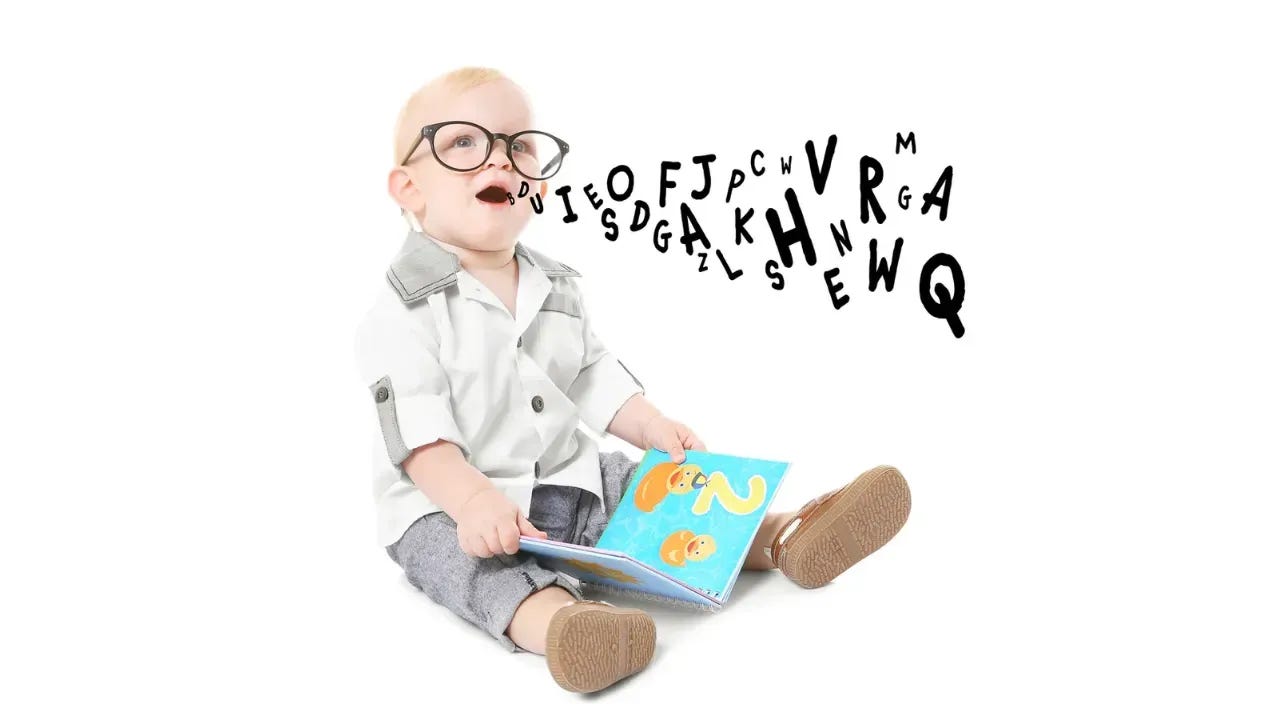
Is it pointless to speak to children before they start speaking themselves? This isn’t necessarily a dumb question. In some cultures parents rarely talk to infants, and those children learn their native languages just fine. How important can talking to your newborn really be if not everybody does it?
Well, pretty important actually. In this week’s article I kick off a 7-part series on the science of baby talk by exploring just how important talking to your child is for their linguistic development:

Articles in the Series
Part 2: What is baby talk?
Part 3: Is baby talk good for your child?
Part 4: Do all cultures use baby talk?
Part 5: Baby talk in the languages of the world
Part 6: How much should you talk to your infant?
Part 7: What really matters when talking to your toddler
The etymology of ‘five’: From Proto-Indo-European to Modern English
Here’s another video from the archives this week!
📰 In the News
Language and linguistics in the news.
World’s oldest alphabet discovered
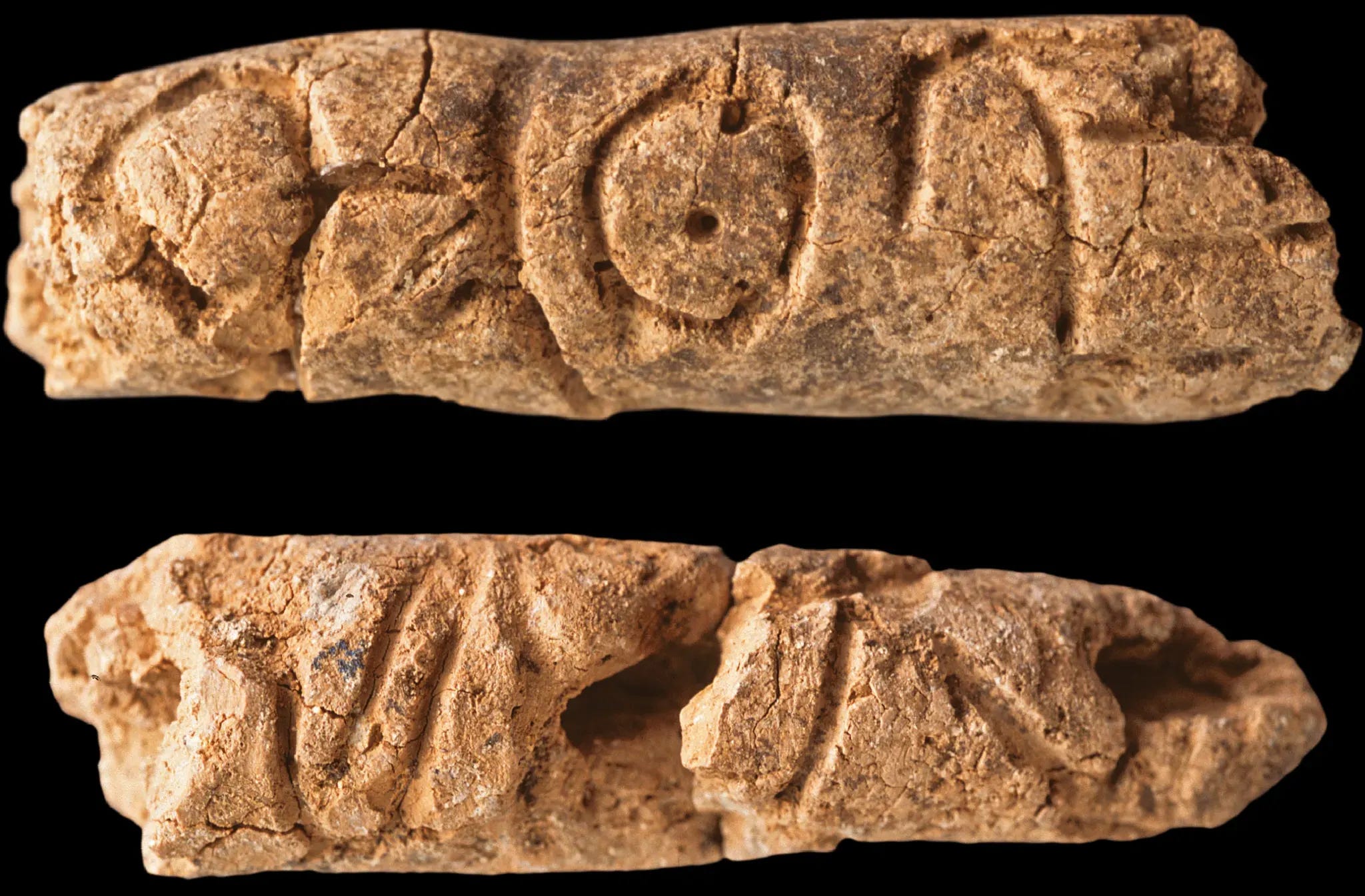
An archaeological team working at a mortuary complex in Umm el-Marra, northern Syria, stumbled upon a collection of clay cylinders incised with symbols that may be the first known instance of alphabetic writing. The cylinders date to 2400 BCE, approximately 500 years earlier than other known alphabetic scripts.
World’s oldest alphabet discovered in Syria (National Geographic)
World’s oldest alphabet found on an ancient clay gift tag (Scientific American)
Archaeologists say these mysterious markings could be the world’s oldest known alphabet writing (Smithsonian Magazine)
Where do writing systems come from?

Sometimes you’ll see it said that all the world’s writing systems descend from three original scripts—Egyptian hieroglyphs, Chinese logograms, or Mayan hieroglyphs:
🗞️ Current Linguistics
Recently published research in linguistics.
One-third of grammatical universals stand up to rigorous testing
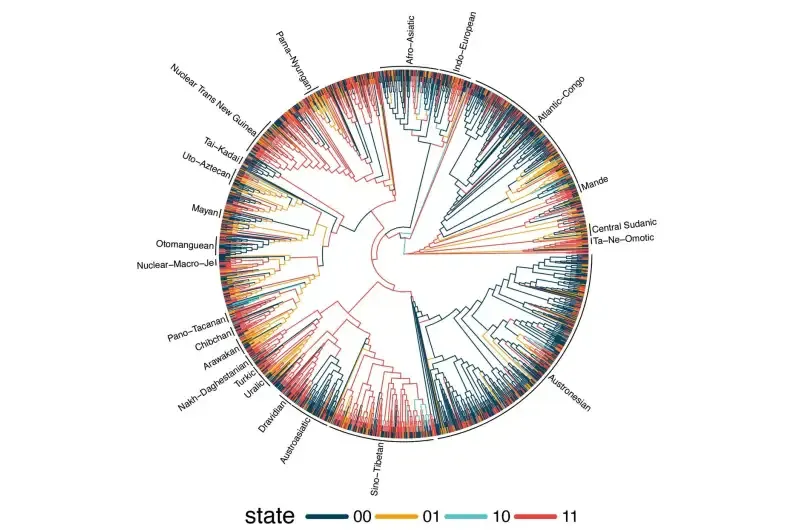
Despite the vast diversity of human languages, certain grammatical patterns appear again and again. A new study reveals that around a third of the long-proposed “linguistic universals”—patterns thought to hold across all languages—are statistically supported when examined with state-of-the-art evolutionary methods.
Below is a research briefing (summary) of the article.
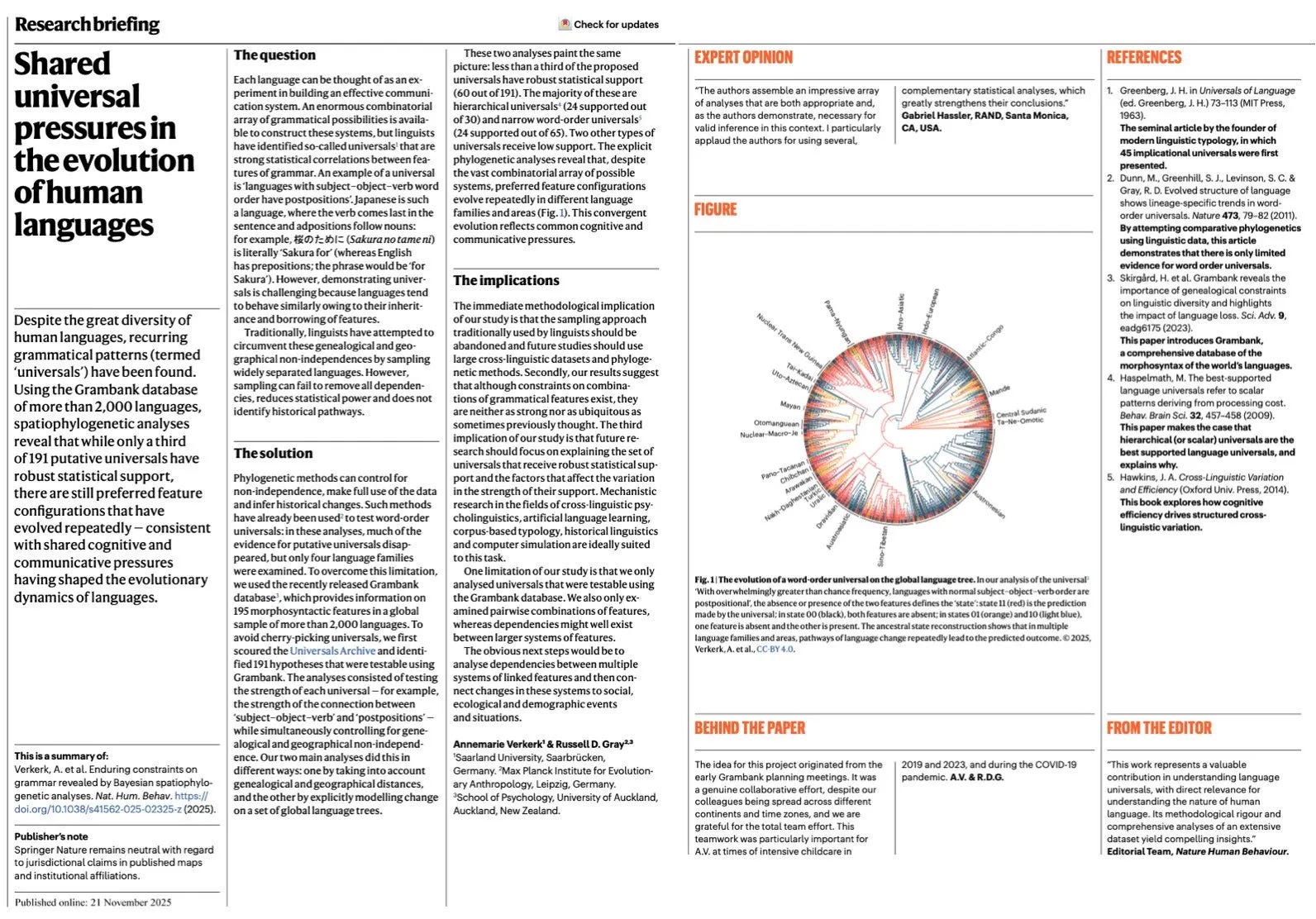
Enduring patterns in the world’s languages: One-third of grammatical ‘universals’ stand up to rigorous testing (Phys.org)
Verkerk et al. 2025. Enduring constraints on grammar revealed by Bayesian spatiophylogenetic analyses. Nature Human Behavior. DOI: https://doi.org/10.1038/s41562-025-02325-z.
Bees understand morse code

Since decoding the “waggle dance” in the 1940s, bees have been at the forefront of research into insect intellect.
A new study shows that bees can be trained to understand the dot-dash behavior of morse code when those short dots and long dashes are associated with sugary rewards.
While bees obviously can’t use this skill with human-level complexity, any level of recognition does provide compelling evidence that bees can differentiate between short and long time durations.
Bees understand morse code. It could change how we see human intelligence (Popular Mechanics)
Davidson et al. 2025. Duration discrimination in the bumblebee Bombus terrestris. Biology Letters 21: 20250440. DOI: https://doi.org/10.1098/rsbl.2025.0440.
📃 This Week’s Reads
Interesting articles I’ve come across this week.
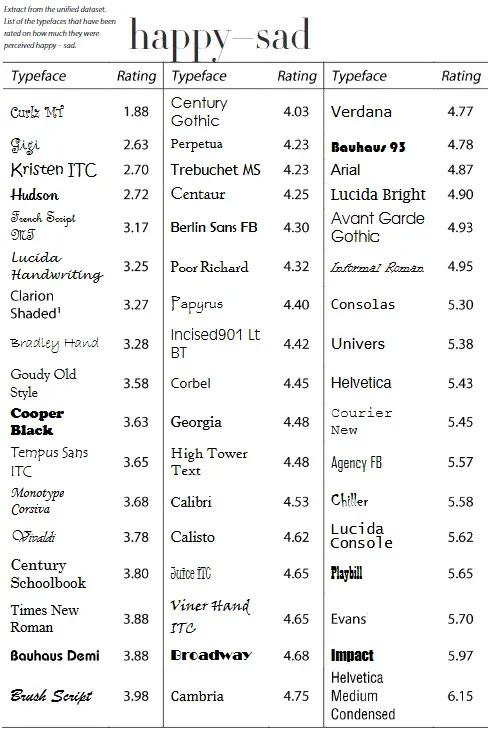
It’s not you—some typefaces feel different (The Conversation)
Here’s a fun summary of some of the data from a study mentioned in this article: How happy–sad each typeface is perceived.
Talking to dolphins isn’t as far away as you might think (Cuteness)
How debt shaped the way we speak: And what it shows about how language works (Dead Language Society)
The linguistic logic behind dropped syllables: What triggers haplology (where speakers omit whole syllables)? (The New World)
Haplology is the phenomenon where speakers drop an entire syllable from a word. This can happen over time, leading to new words (Engla land → England) or as a variation on a current word (probably → prolly).
What is Occitan? Discover its history and what makes it unique (Rosetta Stone)
📚 Books & Media
New (and old) books and media touching on language and linguistics.
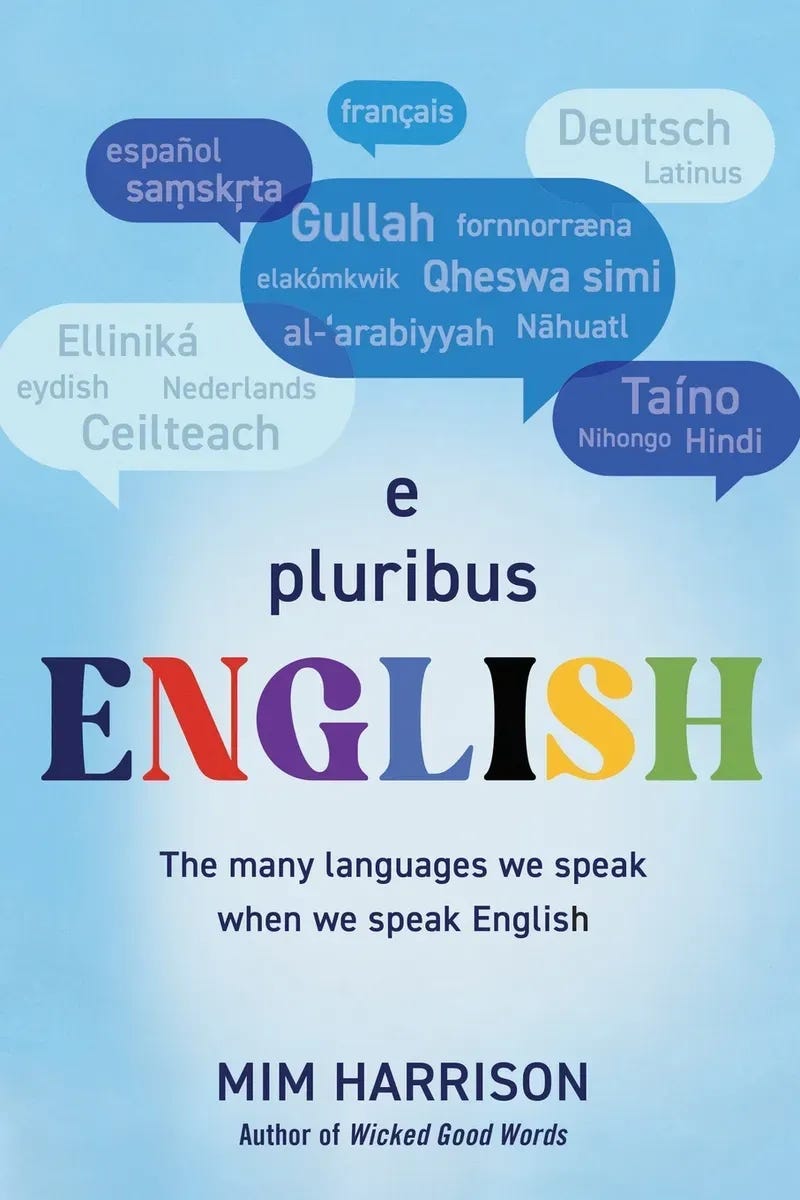
E pluribus English: The many languages we speak when we speak English
English is a language of other languages—and therein lies its magic. A new book explores the etymology of over 450 words:
Inventing languages: A practical introduction
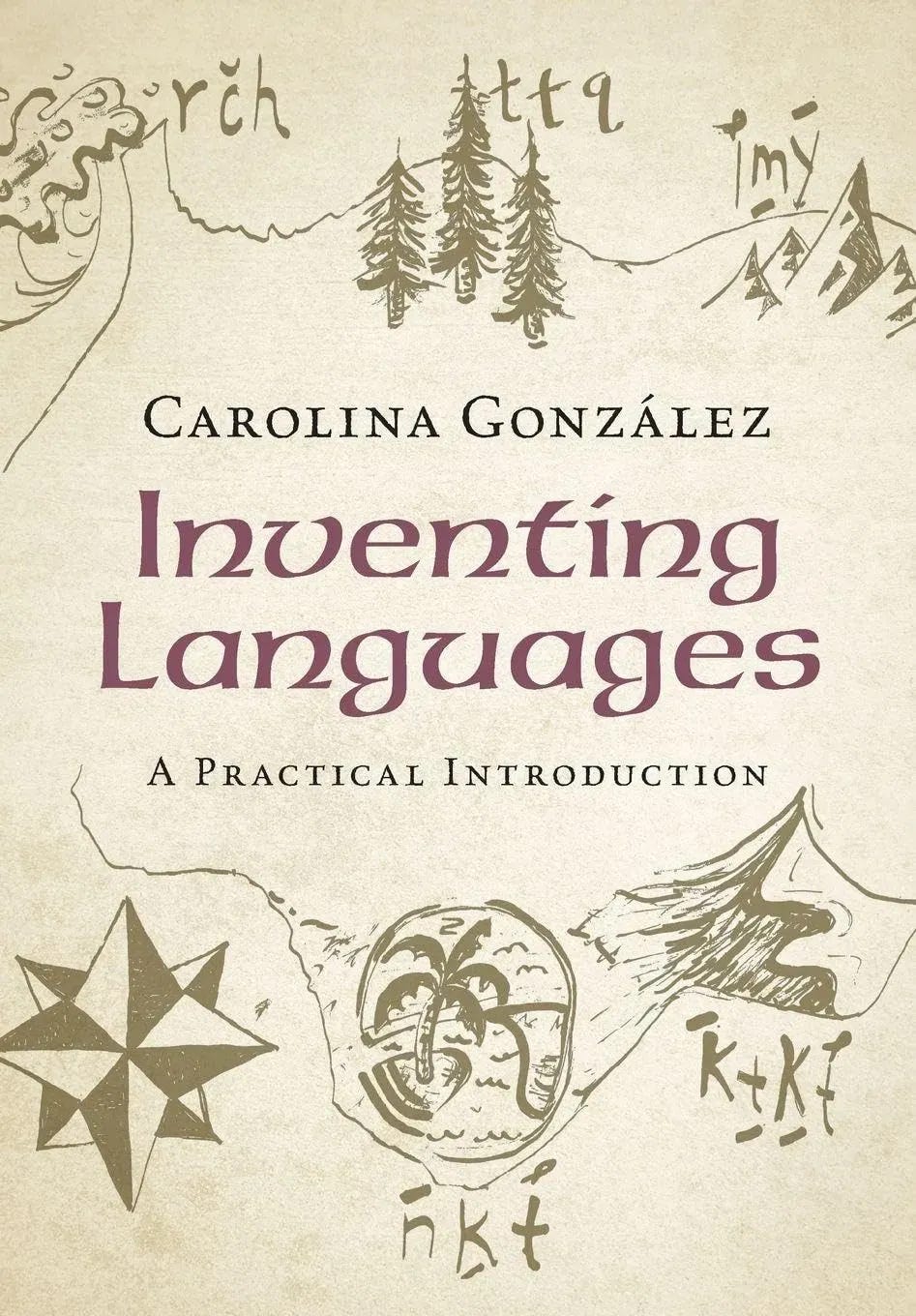
This new textbook on inventing languages was just released, and it looks like a great introduction. I’m not even quite sure “textbook” is the right term, since it doesn’t mention that it’s designed for classroom use in particular, but you could most definitely use it in a conlanging class designed to introduce students to linguistic typology. Otherwise, it would make a great handbook for anybody interested in conlanging.
This would also make a great Christmas gift for the language nerds and creative writers in your life!
👋🏼 Til next week!
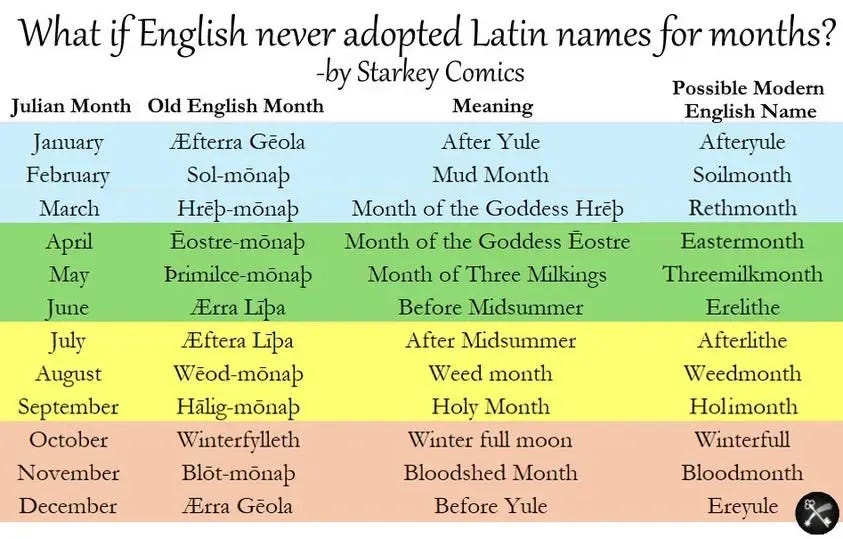
What if English never adopted Latin names for months? From Starkey Comics.
The Amazon and Bookshop.org links on this page are affiliate links, which means that I earn a small commission from Amazon for purchases made through them (at no extra cost to you).
If you’d like to support Linguistic Discovery, purchasing through these links is a great way to do so! I greatly appreciate your support!
Bees/Morse isn't surprising. The waggle dance includes durations that map to distances, remembered via an internal abacus.
https://polistrasmill.blogspot.com/2019/06/astrocyte-abacus.html