

Should you be talking to your infant? The science of baby talk, Part 1
Is it pointless to speak to children before they start speaking themselves?

The word infant comes from the Latin “īnfāntem” ‘unable to speak’.
A TikTok mom recently went viral because she asked:
Does anybody else not talk to their baby? My daughter is 11 months old, and she can’t talk so I don’t talk to her. Is that weird? Should I be just saying things so she can learn how to talk? I make noises, I do funny faces, I dance, but I don’t converse.
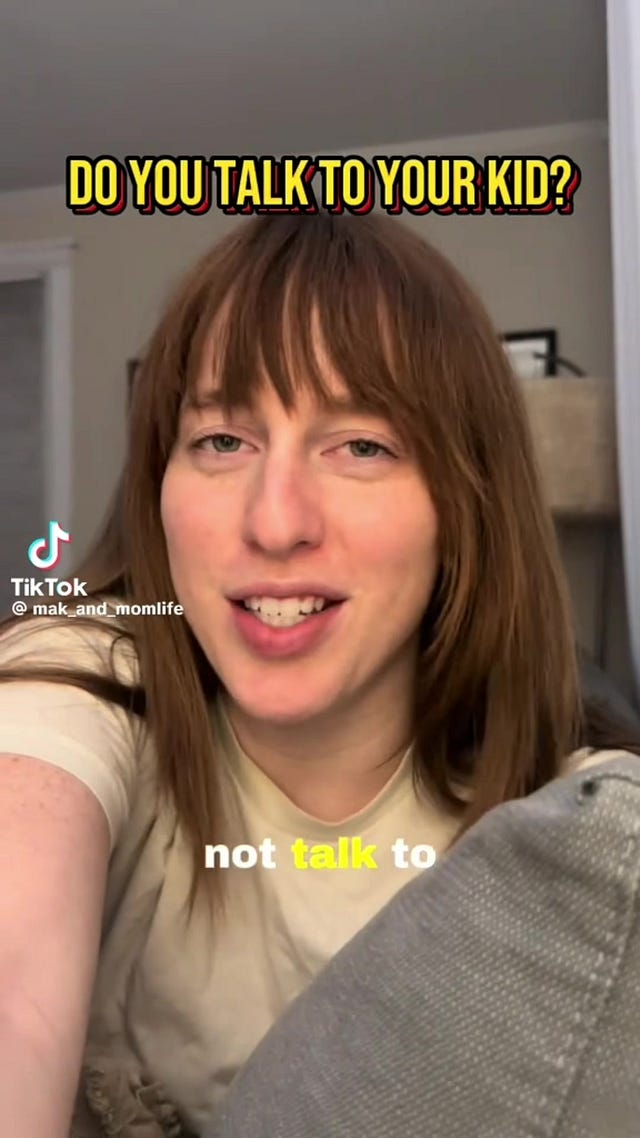
 Tiktok failed to load.
Enable 3rd party cookies or use another browser
Unfortunately this mom was so thoroughly excoriated in the comments and in numerous response videos that she took the original video down.
But this isn’t a dumb question!
If you aren’t familiar with research on child language acquisition, it’s entirely reasonable to wonder whether baby talk is bad for your child, or whether it’s pointless to speak to children before they begin speaking themselves. The word infant itself even comes from the Latin īnfāntem ‘unable to speak’. In some cultures parents rarely talk to infants, and those children learn their native languages just fine. How important can talking to your newborn really be if not everybody does it?
Well, pretty important actually. Even those purportedly low-conversation parents in other cultures actually talk to their kids quite a bit, just in different ways and on different timetables. (We’ll learn more about that in Parts 4 & 5 of this series.)
On the other end of the spectrum, many parents have been terrified into thinking that they’re not speaking to their children enough because of an infamous 1995 study showing that children from lower socioeconomic backgrounds hear up to 30 million fewer words by age 4 than their high-income peers, and that this gap correlates with reduced vocabulary development and educational outcomes.1
But as we’ll see in Part 6 of this series, the sheer amount of exposure kids have to language doesn’t actually make much difference for their language development. Those reported differences in vocabulary size are a) questionable, and b) have more to do with other socioeconomic factors than hitting a daily word count with your toddler.
So in this series, we’ll look at what the research has to say about speaking to your infant, answering the following questions along the way:
ℹ️ Articles in this Series
Part 1: Should you be talking to your infant? (this issue)
Part 2: What is baby talk?
Part 3: Is baby talk good for your child?
Part 4: Do all cultures use baby talk?
Part 5: Baby talk in the languages of the world
Part 6: How much should you talk to your infant?
Part 7: What really matters when talking to your toddler
Subscribe to get notified when the other issues in the series are published!
You’re reading Linguistic Discovery, a newsletter about the science and diversity of language—a field known as linguistics. I’m Danny Hieber, a Ph.D. in linguistics who works with indigenous communities to help them document and revitalize their languages. covered Topics in this newsletter include:
⚙️ how language works (cognitive linguistics, language change)
🌍 grammatical diversity in the world’s languages (typology)
ℹ️ explainers of terms and concepts in linguistics
🗣️ language profiles
🗞️ the latest news and research in language and linguistics
⭐ linguistic reviews of books and other media
Paid subscribers also get bonus articles and early access to my in-progress book projects!
Should you talk to your newborn?
Simply plopping your child on the couch to watch some reality TV won’t teach them language.
Should you be talking to your newborn child? The short answer is decidedly yes. Infants need some type of linguistic input to be able to learn a language—it’s not as though they’re born with an innate knowledge of English or any other language. Instead, they’re born with an incredibly advanced cognitive toolkit that allows them to learn any language they’re exposed to within just a few years.
But that exposure is crucial. We know from cases of extreme childhood neglect that if children aren’t sufficiently exposed to language before puberty (a timeframe known as the critical period or sensitive period in linguistics and developmental psychology), language acquisition becomes significantly more difficult and ultimately less successful. The most infamous and heart-wrenching case is that of Genie, who was confined in a dark room with minimal contact from about 20 months of age until she was almost 14 years old.2
When Genie was finally discovered she was extremely malnourished. Physically, she looked like a 6- or 7-year-old, weighed 59 pounds, had difficulty standing and walking, and couldn’t chew solid food. She never spoke, and seemed to only understand a few words at best. As she was treated and given a healthier cognitive and social environment, her rehabilitation quickly triggered the onset of puberty. Her cognitive development reached that of a 6- to 8-year-old by the following year. After 5 months she began to use single words, and her vocabulary grew quickly. She started to combine two, then three, then four words (1), and after two years she produced apparent cases of embedded clauses (2):
want milk
Genie love Curtissbig elephant long trunk
ask [go shopping]
tell [door lock]
However, Genie never mastered the complexities of English morphology and syntax. All grammatical words and morphology were missing.
Less lurid but still unfortunate cases have also been documented for profoundly deaf children who were not exposed to sign language in childhood. Deaf children who began learning a sign language at age 5 were significantly less fluent than native signers (who are exposed to sign language from birth) even after 30 years of daily use. Those who weren’t exposed to sign language until age 12 or later were profoundly hindered in their ability to learn sign.3
Simply plopping your child on the couch to watch some reality TV also won’t do the trick. (If only it were that easy!) In fact, a 2024 study even found that the greater the total screen time of children aged 2;5 to 4;0 on weekends, the worse their vocabulary and grammar skills.4 Children need social cues to help direct their attention and start associating social meaning with linguistic meaning. One salient illustration of this is the case of Jim, a hearing child born to deaf parents whose only exposure to English was via (a great deal of) television, and whose parents did not generally speak or sign to him.5 By age 3;9, Jim’s language use was decidedly abnormal for children his age:
This is how plane
I want that make
House chimney my house chimney
Jim could learn new vocabulary, but was limited in his ability to form grammatical sentences.
ℹ️ In first language acquisition research, age is written as years;months, so that “3;9” means ‘3 years, 9 months old’.
ℹ️ If you’re concerned that your child’s language development might be abnormal, here’s a summary of developmental milestones you can expect:
Age-Appropriate Speech and Language Milestones (Stanford Medicine Children’s Health)
Other studies6 have shown that children can’t learn new words from television before the age of 2.7 After age 2, it’s possible for children to learn some vocabulary from television, but only from shows designed specifically for children, and only well-designed ones.8 (Children who watched Teletubbies did not show significant vocabulary development, while children who watched Dora the Explorer, Blue’s Clues, or Dragon’s Tales showed greater vocabulary gains.9) One study showed that children only learned new vocabulary from video when an adult facilitated their learning with concomitant social interaction,10 again showing the importance of socially-directed cues for child language learning. By comparison, one study showed that children aged 21–27 months learned new vocabulary from a shared book reading activity, but none from TV viewing.11
Linguist Noam Chomsky actually once claimed explicitly that “a child may pick up a large part of his vocabulary and ‘feel’ for sentence structure from television”.12 Chomsky believes that mere exposure is sufficient for language acquisition, because he thinks that some part of grammar is innate rather than learned, a position known as linguistic nativism. But as Saxton (2017: 131) trenchantly states, “Chomsky’s early assertions about language acquisition are the result of armchair speculation, not empirical enquiry.” In reality, the amount of speech that children overhear does not predict vocabulary size, whereas the amount of speech specifically targeted at them does.13 The body of first language acquisition research has shown that targeted social interaction is crucial for child language development.
So we’ve established that some type of interactive linguistic input is necessary for children to learn language. But what kind of language works best? Baby talk? Normal adult speech? We’ll look at this question in the next two issues of the Linguistic Discovery newsletter! If you haven’t already subscribed, be sure to do so to receive the other issues in this series.
ℹ️ Articles in this Series
Part 1: Should you be talking to your infant? (this issue)
Part 2: What is baby talk?
Part 3: Is baby talk good for your child?
Part 4: Do all cultures use baby talk?
Part 5: Baby talk in the languages of the world
Part 6: How much should you talk to your infant?
Part 7: What really matters when talking to your toddler
Subscribe to get notified when the other issues in the series are published!
“The birth of a word”
MIT researcher Deb Roy wanted to understand how his infant son learned language—so he wired up his house with video cameras to catch every moment (with exceptions) of his son’s life, then parsed 90,000 hours of home video to watch gaaaa slowly turn into water. Astonishing, data-rich research with deep implications for how we learn.
HELLO Lab Presents
The Hearing Experience & Language Learning Outcomes (HELLO) Lab at the University of Connecticut has a great series of YouTube Videos about child language acquisition for parents.

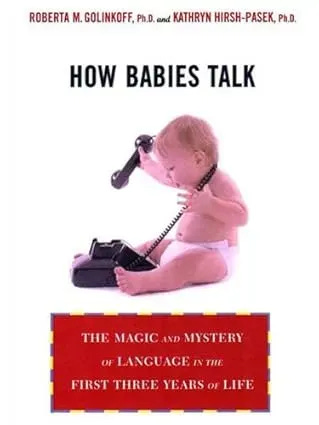
How babies talk: The magic and mystery of language in the first three years of life
📑 References
Anderson, Daniel R. & Katherine G. Hanson. 2017. Screen media and parent–child interactions. In Rachel Barr & Deborah Nichols Linebarger (eds.), Media Exposure During Infancy and Early Childhood, 173–194. Cham: Springer International Publishing. https://doi.org/10.1007/978-3-319-45102-2_11.
Anderson, Daniel R. & Tiffany A. Pempek. 2005. Television and very young children. American Behavioral Scientist 48(5). 505–522. https://doi.org/10.1177/0002764204271506.
Barr, Rachel & Nancy Wyss. 2008. Reenactment of televised content by 2-year olds: Toddlers use language learned from television to solve a difficult imitation problem. Infant Behavior & Development 31(4). 696–703. https://doi.org/10.1016/j.infbeh.2008.04.006.
Chomsky, Noam. 1959. Review of “Verbal behavior” by B.F. Skinner. Language 35(1). 26–58. https://doi.org/10.2307/411334.
Hart, Betty & Todd R. Risley. 1995. Meaningful differences in the everyday experience of young American children. Baltimore: P. H. Brookes.
Krcmar, Marina, Gernard Grela & Kirsten Lin. 2007. Can toddlers learn vocabulary from television? An experimental approach. Media Psychology 10. 41–63. https://doi.org/10.108/15213260701300931.
Kuhl, Patricia K., Feng-Ming Tsao & Huei-Mei Liu. 2003. Foreign-language experience in infancy: Effects of short-term exposure and social interaction on phonetic learning. Proceedings of the National Academy of Sciences 100(15). 9096–9101. https://doi.org/10.1073/pnas.1532872100.
Linebarger, Deborah L. & Dale Walker. 2005. Infants’ and toddlers’ television viewing and language outcomes. American Behavioral Scientist 48(5). 624–645. https://doi.org/10.1177/0002764204271505.
Lust, Barbara. 2006. Child language: Acquisition and growth (Cambridge Textbooks in Linguistics). Cambridge University Press.
Mumme, Donna L. & Anne Fernald. 2003. The infant as onlooker: Learning from emotional reactions observed in a television scenario. Child Development 74(1). 221–237. https://doi.org/10.1111/1467-8624.00532.
O’Doherty, Katherine, Georgene L. Troseth, Priya M. Shimpi, Elizabeth Goldenberg, Nameera Akhtar & Megan M. Saylor. 2011. Third-party social interaction and word learning from video: Social interaction and video. Child Development 82(3). 902–915. https://doi.org/10.1111/j.1467-8624.2011.01579.x.
Patterson, Janet L. 2002. Relationships of expressive vocabulary to frequency of reading and television experience among bilingual toddlers. Applied Psycholinguistics 23(4). 493–508. https://doi.org/10.1017/S0142716402004010.
Rice, Mabel L., Aletha C. Huston, Rosemarie Truglio & John C. Wright. 1990. Words from “Sesame Street”: Learning vocabulary while viewing. Developmental Psychology 26(3). 421–428. https://doi.org/10.1037/0012-1649.26.3.421.
Rice, Mabel L. & Linda Woodsmall. 1988. Lessons from television: Children’s word learning when viewing. Child Development 59(2). 420. https://doi.org/10.2307/1130321.
Saxton, Matthew. 2017. Child language: Acquisition and development. 2nd edn. SAGE.
Shneidman, Laura A., Michelle E. Arroyo, Susan C. Levine & Susan Goldin-Meadow. 2013. What counts as effective input for word learning? Journal of Child Language 40(3). 672–686. https://doi.org/10.1017/S0305000912000141.
Snow, C. E., A. Arlman-Rupp, Y. Hassing, J. Jobse, J. Joosten & J. Vorster. 1976. Mothers’ speech in three social classes. Journal of Psycholinguistic Research 5(1). 1–20. https://doi.org/10.1007/BF01067944.
Tulviste, Tiia & Jaan Tulviste. 2024. Weekend screen use of parents and children associates with child language skills. Frontiers in Developmental Psychology 2. 1404235. https://doi.org/10.3389/fdpys.2024.1404235.
Uchikoshi, Yuuko. 2005. Narrative development in bilingual kindergarteners: Can Arthur help? Developmental Psychology 41(3). 464–478. https://doi.org/10.1037/0012-1649.41.3.464.
The Amazon and Bookshop.org links on this page are affiliate links, which means that I earn a small commission from Amazon for purchases made through them (at no extra cost to you).
If you’d like to support Linguistic Discovery, purchasing through these links is a great way to do so! I greatly appreciate your support!
Hart & Risley (1995)
The following summary of Genie’s case is based on Lust (2006: §5.8.1).
Newport (1990)
Tulviste & Tulviste (2004)
Sachs, Bard, & Johnson (1981)
The following summary of research on language acquisition from television is based on Saxton (2017: 94–96).
Snow et al. (1976); Kuhl, Tsao, & Liu (2003); Mumme & Fernald (2003); Anderson & Pempek (2005); Krcmar, Grela, & Lin (2007)
Rice & Woodsmall (1988); Rice et al. (1990); Barr & Wyss (2008)
Linebarger & Walker (2005); Uchikoshi (2005)
O’Doherty et al. (2011); see also Anderson & Hanson (2017)
Patterson (2002)
Chomsky (1959: 42)
Shneidman et al. (2013)
The contrast between passive exposure (TV) and targeted interaction really emphasizes how language acquisition isn't just about volume but about social scaffolding. The Jim case is particularly revealing becuase it isolates the variable cleanly; having abundant linguistic input without directed cues produces outcomes somewhere between full competence and severe deprivation. I find the critique of Chomsky's armchair speculation especially useful given how often linguistic nativism gets invoked without examining what actual acquistion data shows. The emphasis on socially-directed speech rather than overheard languag also suggests that qualty of engagement matters more than ambient word counts, which feels reassuring for parents who can't maintain constant narration.
Speech and language therapist and linguistics geek here. Love your content, and thought this article was fab. Thanks and can’t wait for the following instalments! 😁